The gap between angler and fish may not be as large as we would like to think, that’s what I am pondering as I look over this year’s catch records. Actually, very interesting to see how the tagging program plays out and what it tells us about our aqueous friends. Like humans, we have our ‘foodies’ that enjoy every morsel, and we have our picky eaters that move along the water’s surface like spoiled children. We have our movers, those that roam the globe for far flung adventures, and we have those that live, breathe and die in the neighborhood in which they were born. Some gain weight really quickly, (must be in the genes!) and some are slow and steady in their growth, and obviously some that, no matter how much they stuff in, can’t seem to put on a pound. Kind of like us when you think about it.
In the years of tagging, it seems that most tagged fish are taken in near proximity to the initial tagging location, or if they have moved, they are in the same general area, having only moved a very small distance. There are a number of fairly mobile fish, Like #396 at Minipi, initially tagged at the Bar of Little Minipi on the 19th of July, then recaptured a year later in August down at Ten Pound Cove, or the one tagged at The First Narrows at Minipi and recaptured at Rose’s Brook. We have a few longer runs, like the little fellows that cruised the system from Shango Bay to Rick’s Run, or the Outlet at Anne Marie up to Lover Boy, relatively good journeys but within the general areas of the same system. And obvious they are chasing food concentration at various times of the years.

Then you get those that really roam from home, the movers and the shakers of the underwater. One of the longest journeys we have noted from the tagging is a Minonipi fish that was caught by Wally Best while setting his net on Lake Melville at the mouth of the Kenamu River – it is almost unreal that a brookie could make such a journey. Wally tells us the brook trout was alive in the net, and it had different colouring from the other brook trout in the haul. When he examined it, he found our tag and called us, we could hardly believe it had made such a journey and indeed, it is the only feedback we have ever received in 35 years that even comes close to confirming such a migration. Given the lay of the land, obviously there would have had to have been very high water at some point to allow this brookie to do the distance up Big Hairy Lake, manoeuver a very shallow brook at the end of Big Hairy, that connects up with the Kenamu River. He was about 2 pounds when Wally discovered him, and a long, long ways from home. Any brookie with a will like that deserved to go on, and Wally said he released him again.
The Cornell Study back in the early 70s showed then that we had about a 15% recapture rate, indicating at the time we were dealing with a very small population of native brook trout. This study strengthened a very strong conservation program that was already in place and provided the science to hold strong to the principal of catch and release.
From our tagging program of ten years ago, we then found that and this holds true to today’s tagging on the watershed, so while he might get away this time, you’ve got at least a 15% chance of seeing this very same fish again. (A subsequent tagging showed the same recapture rate). Very common to tag one day and take this same fish later in the week, and perhaps one or two times more throughout the rest of the season. What is interesting is the weight; taking # 2665 as an example, tagged at 4 ¼ pounds on July 24th one year, and recaptured the 27th of June the following year, at 5 ¼ pounds. This one would have put on more than a pound that initial year as in all cases, a tagged brookie weighted in August and September and caught the following early summer will usually be down ¼ – ½ of a pound from the year prior, obviously from the over-wintering. I also find interesting that the “movers” have a smaller weight gain, especially those battling fast waters in their travels, # 10 was tagged at 5 ¾ pounds in July at the Second Narrows at Minipi, taken two years later on the Little Minipi River at 6 pounds only, what a journey! But anyone knowing the terrain would know the energy expended to traverse that river.

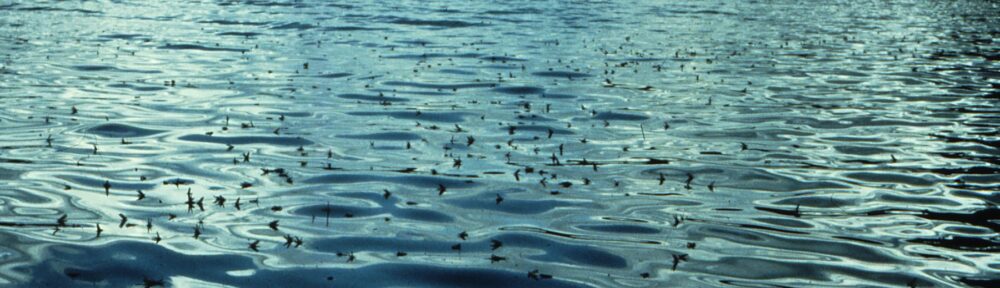
You get some of these particularly good hatch years and what the brookies can put on in a matter of weeks is remarkable as well. Couple of years ago, we had # 341, a male, tagged at 6 ¾ pounds at the Bar by Kelly Groves, then ten days later, Kelly with the same scales and different angler recaptured # 341 and recorded the weight now at 7 pounds. Feeding all day, and indeed all night, that is what happens. Another story I remember from our Chief Guide, Raymond Best, about a filming session he was doing with Jack Hegarty. It is not uncommon for us to fish well into the darkness, but on this one particularly wonderful fishing evening over at Green Pond (Minonipi) when the sun had gone down, Jack happened to shine the camera light upwards and they were amazed. Green Pond was literally ‘snowing’ with bug life and both remarked at the sounds in the darkness of brookies breaking the water and slurping in the dark. I remember laughing at Raymond’s remark that night, “No wonder the next morning we head back out and we get nothing more than a big burp … they’re so full from last night’s feeding frenzy.”
Whatever the personality of these brookies, whether they choose to be born and raised at Lover Boy, never moving more than a few feet, or whether they’re the shakers in the brook trout world, breaking the bounds of all that they know to swim the Kenamu to Lake Melville, the delicate little feeders or those with ravenous appetites … to understand what makes them special is a fascinating science in itself. What we do know, and have so much more to learn about, is that this is a small population of brook trout that grow large in this Minipi watershed, thanks to the abundant food source and the particular lay of the shallow lake beds. Add the remoteness of the resource and a good conservation program from day one, and you have, still, fishing as good as it was a generation ago.